
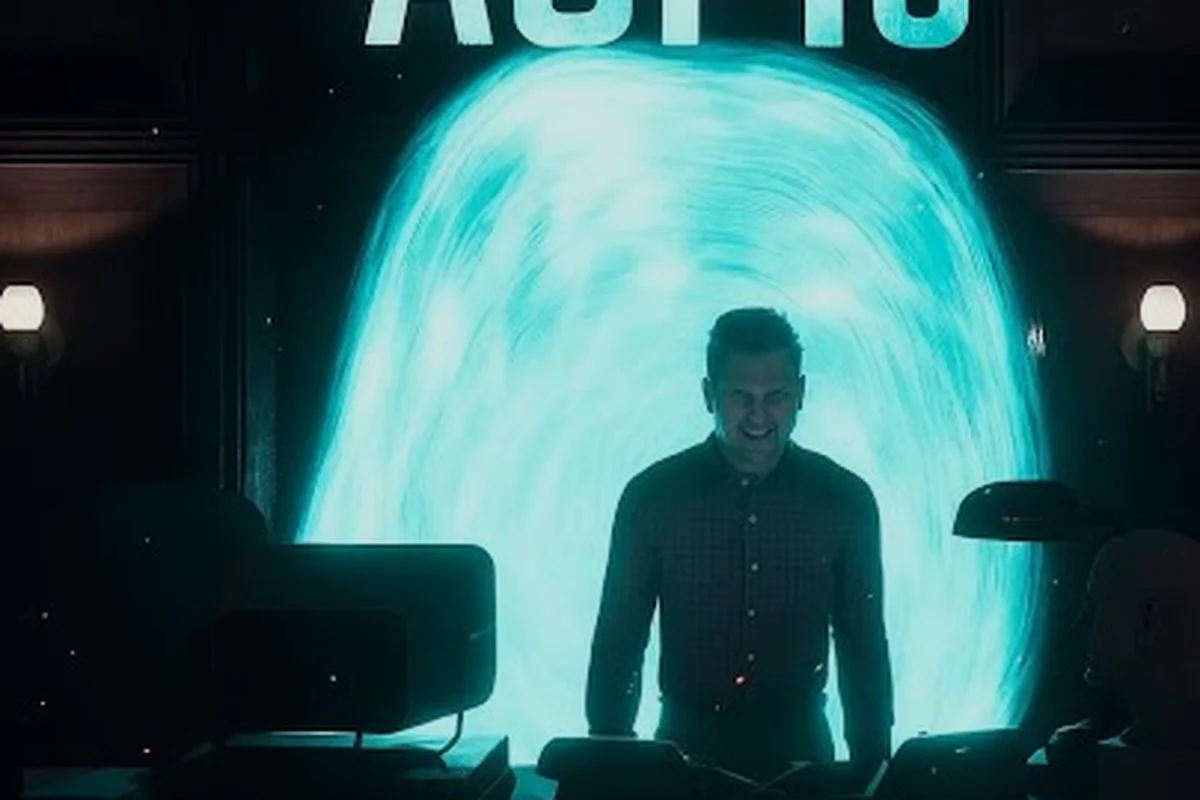
ASPIS documents matter because they preserve official clues about OGAS, the volunteer experiment, the entities beyond the Institute, and the layered world reached through astral windows. Read them as a linked evidence trail, and the collection becomes the clearest route into ASPIS theories, myths, dimensions, and the question of whether reality is simulated.
ASPIS Documents as the Experiment’s Narrative Record
The official ASPIS page on Steam presents records as the principal way the story reaches the player. In the USSR in 1987, engineer Andrey enters an experiment connected to the Institute of Cybernetics, six volunteers, and OGAS terminals. The documents preserve that history in fragments, so their ordering, terminology, and physical condition can reveal how the experiment affected everyone involved.
Autonomous System for Predicting Historical Events is the expanded name of ASPIS. That phrase suggests a prediction system, but the records repeatedly place ordinary bureaucratic language beside events that do not obey familiar laws. The contrast is important: the people operating the system describe their work as research, while their documents contain procedures and warnings for phenomena that have no accepted scientific explanation.
Those records also establish the narrative baseline: together, the ASPIS documents trace the six volunteers’ assignment and the OGAS experiment’s development from formal research paperwork into evidence of Energy X, astral windows, and phenomena that resist the Institute’s usual explanations. Their damaged pages, shifting terminology, and conflicting observations provide clues about the 1987 USSR setting, while also distinguishing documented procedures from later interpretation, giving the player a chronological framework for assessing the experiment’s unfolding.
-
Andrey is the engineer at the center of the story.
-
Anna, Andrey’s deceased wife, and his daughter Liza shape his emotional motivations.
-
Six volunteers enter an experiment that was expected to last days.
-
well over a year elapses inside the system, while none of the volunteers has awakened.
-
OGAS terminals connect the researchers to the places and entities that appear beyond the Institute.
-
The PEP-01 device interacts with Energy X and opens astral windows between layers of reality.
That combination makes ASPIS documents more than collectible background. They show characters changing their understanding of the system before the player does. A routine memorandum can become unsettling when its instructions imply that a place listens, responds, or has rules independent of the operator.
What the Records Establish as Fact
| Record type | Information it supports | Why it matters to the lore |
|---|---|---|
| Official correspondence | The Institute, OGAS, and the volunteer experiment existed | Grounds the story in Soviet research culture |
| Technical files | PEP-01 interacts with Energy X and astral windows | Connects equipment to the layered spaces |
| Personal records | Andrey, Anna, and Liza remain emotionally important | Shows that the system’s effects are personal |
| Later testimony | Time inside the experiment moves far faster than outside | Separates subjective duration from the external timeline |
| Operational warnings | The environment contains hostile or incomprehensible phenomena | Signals that OGAS is not a conventional terminal |
The safest approach is to distinguish a direct statement from an inference. Official material confirms the setting, named people, experiment, terminals, devices, entities, and broad consequences. It does not explain the experiment’s mechanism, the eventual outcome, or whether the events are simulated. Any claim beyond that boundary belongs in the realm of interpretation.
The Central Documentary Contradiction
The most productive tension in ASPIS documents is between institutional certainty and lived impossibility. Researchers use forms, procedures, and technical language, yet the world inside the system responds in ways that cannot be contained by their paperwork. One document may sound routine; another may expose the cost of entering that routine.
A useful reading practice is to separate four layers: the document’s stated purpose, the writer’s institutional position, the events recorded, and the assumptions embedded in the language. For example, a routine ASPIS research report may document a containment procedure, yet a discrepancy in an attached observation or repeated date can reveal that the procedure did not function as claimed. This layered approach preserves the difference between ASPIS myths, ASPIS entities, and claims about ASPIS dimensions, while avoiding the temptation to treat every anomalous detail as proof of a simulation.
-
The speaker: What role does the writer hold, and what could that person know?
-
The observation: What happened without interpretation?
-
The explanation: Which institutional or folk belief is being offered?
-
The contradiction: Which detail conflicts with another record?
This method keeps ASPIS theories from becoming a contest between invented facts. It shows where the narrative itself is unreliable and where the official premise leaves the mystery open. The ASPIS story overview provides useful context for placing the documents within the wider family tragedy and Institute storyline.
OGAS Clues Across the ASPIS Archive
OGAS is the archive’s central system and the clearest route into the broader guide to ASPIS and OGAS. The records do more than name the terminals: they show OGAS as a mediator between human intent and an environment that may be autonomous, alive, or composed of rules unfamiliar to its operators. Every mention should therefore be read in context.
The official description presents OGAS terminals alongside the Institute, the six volunteers, and astral windows. This places OGAS at the technical heart of the story. It appears to be a way to access, influence, or observe the spaces reached by the experiment, but the exact function is not publicly explained. It is safer to say that OGAS mediates contact than to assign it a precise operating principle.
Reading Terminal Language
Terminal language can be divided into three categories: literal command-and-status output, identity-bearing responses that recognize the operator, and rule-governed references to entities, locations, or volunteer-related operations. These categories support different inferences: reliable instructions suggest OGAS can map human requests into actions; anticipatory replies hint at a predictive model; contradictions and unstable wording more often indicate archive damage, layered dimensions, or a distorted record. The confidence differences in the table therefore reflect the strength of each textual signal, not a simple binary between a conscious OGAS and an ordinary terminal.
| Language pattern | Likely inference | Confidence |
|---|---|---|
| Standard commands and status messages | OGAS can translate human instructions into actions | High |
| Responses that anticipate the operator | The system may model or anticipate intent | Medium |
| References to rules, entities, or locations | Those subjects have a stable internal logic | Medium |
| Unstable or contradictory text | The archive may be damaged, filtered, or layered | Low to medium |
| References to waking the volunteers | The volunteers remain relevant to the system’s operation | High |
OGAS is not simply a computer terminal in the lore. The official framing calls the system predictive, while the environment around it behaves less like a passive machine. That gap allows a central ASPIS theory: OGAS may not merely predict history but create or preserve a domain whose behavior resembles history on a scale the volunteers cannot control.
Still, readers should avoid turning every anomaly into proof of sentience. A strange response may reflect a damaged archive, a different dimension, a time discrepancy, or deliberate manipulation by another intelligence. The documents become convincing when several independent record types support the same interpretation.
OGAS and the Passage of Time
Official announcements state that time inside the experiment moves hundreds of times faster than outside, while the planned experiment lasts only days on the outside. The official site adds that one year has passed and none of the six volunteers has awakened. These facts make the documents unusually valuable because they can expose how institutional timekeeping breaks down.
A report written before the experiment may be read long after its intended context. A note describing a recent event may coexist with a page written months earlier. If the document set includes dates, revisions, or crossing-out, treat them as clues rather than conventional chronology. Accelerated time can explain conflicting testimony, but it cannot by itself explain changes in physical rules, so the strongest theories combine temporal displacement with layered space.
The larger history of the Institute and its terminal work can be examined through the ASPIS project timeline. That background helps distinguish evidence about OGAS from speculation imported from other Soviet-cybernetics stories, such as the idea that the experiment generated autonomous entities or that altered space and time were deliberate features. The distinction matters because claims about OGAS entities, layered dimensions, or simulation-like conditions become more credible when their effects are tied to specific ASPIS documents and institutional phases, rather than treating every anomaly as proof of the same phenomenon.
ASPIS Entities and the Meaning of the Guardian
The official material names several entities without fully defining them. That makes ASPIS entities unusually important to the lore: they show that the world beyond the Institute has its own inhabitants, rules, and methods of resistance. Yet their appearance should not be confused with a comprehensive bestiary, because the game does not publish every creature or explain its taxonomy.
Among the official names are the Guardian, the Cat, the Director, and the Devil figure associated with a cage. Their roles differ. The Cat helps Andrey read the rules of the place, the Director leads him deeper while promising answers, and the Guardian is described as something that cannot simply be shot. These details imply agency without fully disclosing motive.
A Working Entity Taxonomy
| Entity or figure | Official clue | Safe interpretation | Caution |
|---|---|---|---|
| Guardian | It cannot simply be shot | Conventional force may not be an effective answer | The official source does not explain its origin |
| Cat | Helps Andrey read the rules | A guide, translator, or intermediary | It may still have a separate agenda |
| Director | Leads Andrey deeper and promises answers | It controls access and information flow | Promises are not confirmed truths |
| Devil figure | Linked to a cage and an achievement | A figure within the mythology of the place | The cage may be symbolic as well as literal |
| Freed prisoner | Found at the edge of the island | A person or intelligence remains inside the environment | The records do not fully explain the identity |
This taxonomy separates observation from theory. An entity’s appearance tells us that the world contains beings or intelligences beyond the volunteers. Its behavior, dialogue, and relationship to OGAS support narrower interpretations. What it ultimately represents requires a thematic comparison across records.
The Guardian as a Test of Assumptions
The Guardian provides a particularly clear example of ASPIS myths forming. Andrey arrives with the assumptions of a world where firearms and melee attacks are familiar tools. The official store description confirms a Makarov pistol, ammunition, and melee combat, but also says the Guardian cannot simply be shot. The contrast establishes a core rule of the place: technological familiarity does not guarantee effective control.
This is why the entity should be read as a narrative device, not just an enemy. It challenges the assumption that the volunteers can treat the new environment as another industrial worksite. If ordinary violence fails, progress depends on observation, interpretation, and knowledge of local rules. The combat system and the lore therefore reinforce each other: weapons matter, but they do not explain the world.
The Devil’s cage offers a different mystery. A prison implies a captor, a captive, or both. Official achievement language confirms that the cage can be broken and a prisoner can later be heard outside, but it does not define the captive’s identity or moral alignment. A theory that treats the Devil as simply evil may ignore how the game repeatedly gives familiar labels to unfamiliar roles. Inverted myth remains a possibility, not a confirmed solution.
To compare the archive’s symbolic figures with character-focused interpretation, see the analysis of whether the Devil is real. That article can help separate the entity’s documented role from the meaning players assign to it.
ASPIS Dimensions, Astral Windows, and Layered Reality
The phrase “layers of reality” is official, and the PEP-01 opens astral windows between them. This makes aspis dimensions one of the most grounded interpretations available: the documents and the explorable environment both point toward a structure made of distinguishable realities. The open question is whether those layers are physical places, states of consciousness, historical periods, or something the terms used by the characters do not adequately describe.
An astral window is more than a fast-travel device. It is the mechanism connecting the Institute to other realities and the one object that makes the notion of dimensions central to the story. Since the official source associates the PEP-01 with Energy X, documents mentioning the device may also connect the layered spaces to Energy X, although the exact relationship remains unexplained.
How the Dimension Clues Fit Together
| Clue | What it supports | What remains uncertain |
|---|---|---|
| Astral windows connect layers | The world contains multiple accessible realities | How many layers exist |
| PEP-01 opens the windows | A physical device mediates movement | Whether it controls or only enables passage |
| The Cat helps Andrey read the rules | Rules differ between spaces | Whether every layer has separate rules |
| The Director leads Andrey deeper | Exploration proceeds through further strata | Whether “deeper” means spatial or conceptual depth |
| The red world and unusual structures | The environment changes beyond the Institute | Whether each shift is a new dimension or a condition |
| A final choice produces two endings | The experiment culminates in divergent outcomes | Whether divergence occurs in reality or history |
The strongest dimension theory treats the archive as a map with incomplete coordinates. Each record may come from a different layer, and references to a familiar person or place can be altered by the context in which the page was found. Repeated names, altered relationships, and warnings about local rules are more meaningful than a simple count of locations.
Time, Space, and the Red World
Accelerated time adds another axis to the layered model. A record may be physically stored in the Institute but belong to another era, while a note about the volunteer experiment may be encountered after events that should occur years later. The analysis of the red world can therefore be read alongside this dimensional framework: the unusual environment may represent a reality layer altered by the experiment rather than a conventional map.
There is also a symbolic layer. A move from the Institute into an astral window resembles a transition from bureaucratic order into a world that reflects its operators. The Institute tries to classify, predict, and control. The deeper spaces reward those who can interpret local behavior rather than impose familiar procedures. This theme can explain why the documents change in meaning as Andrey travels: the same warning may refer to a physical rule in one place and a social or psychological rule in another.
The test for a good dimensional theory is consistency. It should explain the astral windows, the Guardian’s resistance to familiar force, the Cat’s rule-reading role, and the Director’s control over access. It should also leave room for official ambiguity rather than claiming a hidden technical answer the developers have not provided.
ASPIS Myths, Records, and Competing Interpretations
ASPIS myths are not merely old folk stories. They are the conceptual language through which the Institute and the volunteers try to describe realities that exceed their instruments. The archive turns folklore into a record of interpretation: an unusual creature may enter a report, a machine may acquire ritual rules, and an ancient image may be copied into a modern operational diagram.
This creates a major interpretive split. One approach reads the myths as literal explanations supplied by the world. Another treats them as psychological metaphors for trauma, grief, guilt, or altered consciousness. A third approach sees them as hybrid mechanisms: the image carries real power even if its origin is uncertain.
Comparing the Main ASPIS Theories
| Theory | Evidence it explains | Evidence that limits it | Best use |
|---|---|---|---|
| OGAS is an autonomous predictive intelligence | Its predictive name, changing responses, terminal access | Its origin and motives are not confirmed | Explains why the system seems to exceed its operators |
| The experiment is simulated | Sudden rules, layered spaces, repeated conditions | The official site says ASPIS was a bridge, not a simulation | Explains inconsistencies without treating them as random |
| The layers are dimensions | Astral windows and accessible realities | Their origin and number are undisclosed | Organizes shifts in rules, place, and time |
| The myths are literal | Named entities, cages, prisoners, supernatural imagery | Symbolism remains possible | Supports entity-centered readings |
| The myths are psychological | Grief, memory, and subjective time are central | It may not explain every hostile phenomenon | Interprets the human cost of the experiment |
| History is being rewritten | OGAS predicts historical events | The mechanism and outcome are not explained | Connects the Institute to the larger premise |
No table of theories can settle the mystery because the official material deliberately leaves the experiment’s mechanism and outcome unexplained. The value of the theories is comparative. Each one highlights certain records while forcing the reader to account for the exceptions.
Community reports can add observations about ambiguous endings, recurring imagery, or how particular records appear, but they should never be treated as official confirmation. A useful theory is not merely dramatic; it is document-compatible. It distinguishes what a page literally says from what the reader infers, and it survives at least one contradictory clue.
The Simulation Question
The question behind “aspis is it a simulation” has a surprising official wrinkle: the official site says ASPIS was not a simulation, but a passage into spaces whose physical rules stop matching our own. That statement appears to reject one simple label while leaving the underlying mystery open. A simulation might be one way to describe a place with generated rules, repeatable events, or detached perception, but the developers’ wording instead points toward passage.
The documents can preserve the simulation theory without proving it. Repetitions, resets, altered time, and impossible geography may look computational. They may also reflect layered realities, distorted memory, or a system that turns historical prediction into lived conditions. A responsible conclusion is that simulation language describes the experience, while bridge language describes the official framing.
For a focused examination of the final decision and divergent outcomes, ASPIS ending theories can be connected to the document trail. The key question is whether the records present the choice as a response to a system, an escape from a generated world, or a decision that changes the experiment itself.
A Method for Reading the Full ASPIS Document Set
A reliable reading method prevents isolated notes from being mistaken for complete answers. Begin with the record’s physical context, identify its speaker, compare it with one institutional source and one personal source, and only then attach a myth or theory. The process takes time, but ASPIS theories become much stronger when they rest on a network of records rather than one striking sentence.
A Five-Step Document Analysis
-
Transcribe the claim: Record exactly what the document says without adding an interpretation.
-
Classify the source: Decide whether it is technical, administrative, personal, operational, or mythological.
-
Date it internally: Compare names, procedures, and references to see when it could have been written.
-
Cross-check one contradiction: Find another record that supports, limits, or complicates the claim.
-
State the confidence: Label the conclusion as confirmed, plausible, or speculative.
| Document signal | Interpretation priority | Reliability note |
|---|---|---|
| Repeated technical phrase | Establish terminology | Stronger when found in multiple records |
| Administrative inconsistency | Suggests pressure or concealed context | Needs a second example |
| Personal testimony | Reveals subjective experience | May conflict with technical records |
| Symbolic name | Useful for thematic comparison | Weak on its own |
| Reference to an entity | Confirms the entity’s presence | Does not prove a literal origin |
| Reference to a dimension | Supports layered-space theory | Does not establish origin or count |
| Ending-related statement | Points toward interpretation of the choice | Outcome details remain open |
This method is especially helpful with ASPIS myths because the same image can have literal, symbolic, and mechanical significance at once. A cage might enclose a body, represent a trapped identity, or mark a boundary that the player can cross. The record may support all three readings without choosing one.
The Puzzle and Document Connection
Some archive material functions as more than lore; it may require interpretation to advance the investigation. The puzzle-focused ASPIS document-reading guide can help with that practical layer, especially where Energy X, X-spheres, and backtracking connect clues to exploration. A theory becomes less convincing when it ignores the order in which the player actually finds the evidence.
Keep two columns while reading: one for documented facts and one for interpretations. A third column can list unresolved contradictions. This simple system prevents a hypothesis about the simulation from swallowing every odd detail, because each proposed explanation still has to face the records that do not fit.
The method also clarifies the value of returning to old pages. After learning a new rule in a deeper layer, an earlier warning may be reread as a practical instruction rather than folklore. That does not prove the layer is simulated; it shows how knowledge changes the apparent meaning of the archive.
What the Archive Still Cannot Confirm
The documents establish a strong framework but not a complete solution. They confirm the alternate-history setting in the USSR in 1987, the Institute of Cybernetics, OGAS, six volunteers, the PEP-01, astral windows, Energy X, and the presence of distinct entities. They also establish that time changes dramatically inside the experiment and that Andrey eventually faces a choice associated with two endings.
They do not publicly settle several important questions, and the omissions are often more revealing than the explicit claims: the archive never defines OGAS in technical terms, identifies how the astral windows interact with the PEP-01, or explains why Energy X appears during the experiment. The six volunteers’ testimony adds another layer by recording radically different timelines, yet the documents do not reconcile those accounts or establish whether the entities encountered inside the layered spaces are autonomous beings, projections, or historical presences. As a result, the same ASPIS document can support multiple readings without allowing the underlying uncertainty to be mistaken for a confirmed mechanic.
-
Whether OGAS is conscious, autonomous, or merely capable of highly complex prediction.
-
Whether the layered spaces are dimensions, historical states, constructs, or something else.
-
Whether the apparent simulation is literal or a metaphor for a bridge.
-
Whether the entities have origins in folklore, history, or the system itself.
-
What mechanism allows one final choice to yield two endings.
-
Why the volunteers remain connected after the experiment should have ended.
-
What Energy X is, beyond its documented interaction with the PEP-01.
This boundary is not a weakness in the lore; it is what makes interpretation valuable. The archive gives players enough structure to reason about the world while leaving the deepest answer open. Community theories can organize the evidence, but they should never erase the distinction between a confirmed fact and a convincing story.
The final takeaway is straightforward: ASPIS documents work as a decentralized archive of reality, not as a conventional collection of exposition. Their names, gaps, conflicts, and recurring entities gradually reveal that the Institute lost control of the system it designed. The strongest interpretation is the one that connects OGAS, the entities, the accelerated timeline, and the layered spaces while remaining honest about what the official record leaves unexplained.
Frequently Asked Questions
What are ASPIS documents used for in the game?
ASPIS documents preserve the Institute’s research history, OGAS terminology, volunteer testimony, and warnings about entities and altered environments. They help reconstruct what happened to Andrey and the six volunteers while revealing that the team’s familiar scientific assumptions stopped working inside the experiment. The official ASPIS store page presents records as the main narrative-delivery channel.
Do the ASPIS documents prove that reality is simulated?
No. The records contain evidence that can support a simulation reading, including rule changes, impossible geography, and accelerated time, but the official site instead describes ASPIS as a passage into spaces whose physical rules stop matching our own. The documents therefore support the question without confirming one answer. A bridge, a simulation, and a layered reality can share several of the same observable symptoms.
What are the most important ASPIS entities mentioned in the records?
The official material names the Guardian, the Cat, the Director, and a Devil figure associated with a cage. The Guardian resists conventional shooting, the Cat helps Andrey understand local rules, and the Director guides him deeper while promising answers. Their roles are documented, but their origins and complete motives are not, which leaves room for several ASPIS myths without establishing which one is canonical.
How do ASPIS dimensions connect to astral windows?
The official description says the PEP-01 opens astral windows between layers of reality, making astral windows the clearest evidence for ASPIS dimensions. The windows connect the Institute to environments with different rules, while the accelerated passage of time makes document dates and personal testimony harder to interpret. Their origin, number, and precise nature remain undisclosed.
Which ASPIS theories best explain the archive without inventing facts?
The strongest theories compare OGAS’s predictive role, the layered spaces, the entities, accelerated time, and the final choice. A simulation explanation accounts for inconsistencies, while the official bridge description offers a competing framework; layered reality and psychological symbolism can explain portions of the evidence. Any reliable theory should distinguish direct document claims from inference and account for contradictory records.