
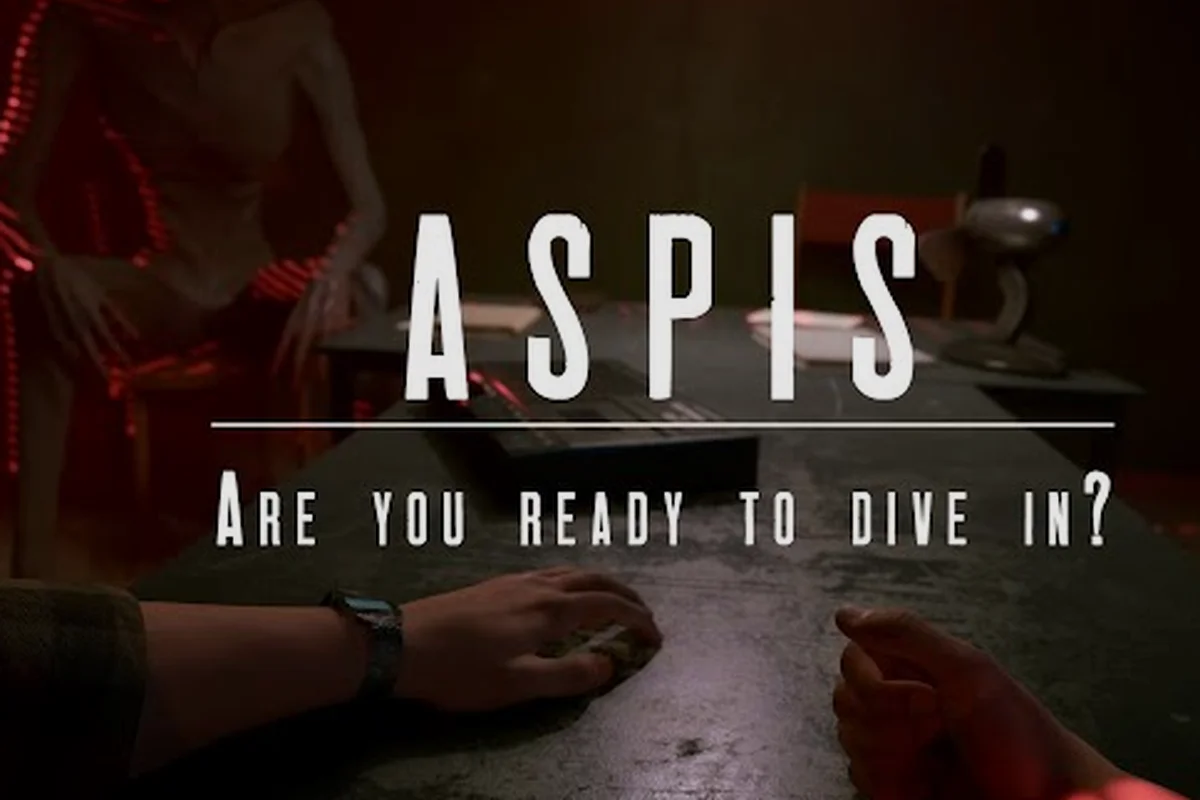
ASPIS stands for Autonomous System for Predicting Historical Events, a phrase printed in the footer of Dream Wire Games' official site. That single line is the whole official answer; the studio does not explain how the acronym relates to the 1987 experiment, the six volunteers, or the Institute of Cybernetics. This guide keeps the confirmed expansion separate from interpretation.
ASPIS Meaning and Official Acronym
If you are searching for aspis what does aspis stand for, the official answer is Autonomous System for Predicting Historical Events. The acronym appears in the footer of Dream Wire Games’ official website, giving the game a title that connects directly to its alternate-history premise and the experiment surrounding its characters.
That matters because ASPIS is more than a decorative title. It describes the system at the center of the story, where six volunteers enter a place that operates under unfamiliar rules. The game takes place in a reimagined USSR in 1987, so the name combines ideas of technological prediction, historical change, and the instability of reality itself.
| Official element | Confirmed meaning or detail |
|---|---|
| Full acronym | Autonomous System for Predicting Historical Events |
| Developer and publisher | Dream Wire Games |
| Historical setting | USSR, 1987, in an alternate history |
| Main character | Andrey, an engineer |
| Other central figures | Andrey’s deceased wife Anna, his daughter Liza, and the Cat |
| Experiment participants | Six volunteers |
| Release | October 23, 2026, on Steam and VK Play |
The official website also says ASPIS is not a simulation, but a bridge to a realm where ordinary laws no longer behave as expected. Time inside the system moves much faster than outside, and the official launch trailer gives the clearest atmospheric introduction to the project. These details explain why the acronym refers to prediction: the system is designed as an instrument for observing or changing events, while the characters discover that its purpose is more dangerous and ambiguous than the technology initially suggests.
ASPIS Setting, Characters, and the Experiment
ASPIS presents a blend of Soviet-era science fiction, psychological horror, and alternate-history speculation. The official Steam page places the story in the Soviet Union in 1987, but not in a straightforward historical reconstruction. The world is an altered version of the period, and its locations draw on photographs of real research institutes, factories, and warehouses that the developer used while building the game.
That combination helps explain aspis similar games comparisons without reducing ASPIS to a copy of any one title. It uses recognizable institutional architecture and the atmosphere of late Soviet research culture, but the central experience comes from a supernatural system, shifting reality, and a small group trying to understand why their experiment did not end as planned.
The six volunteers
The premise begins with six volunteers connected to the experiment. Official material does not publish a complete roster of biographies, difficulty rules, or individual abilities. Even so, the group’s defining feature is clear: after more than a year, none has awakened from the system. Their absence becomes a source of dread because the characters must determine whether returning is possible and what returning would mean.
Andrey is the main point of entry. He is an engineer, but the story also follows his personal losses through his deceased wife, Anna, and his daughter, Liza. The Cat serves a different narrative role by helping Andrey interpret the rules of the strange environment. The official site describes the Cat as a guide, while the Director promises Andrey deeper access and more answers.
| Story element | Function in ASPIS |
|---|---|
| Andrey | Engineer and primary playable perspective |
| Anna | Andrey’s deceased wife, connected to the emotional stakes of the experiment |
| Liza | Andrey’s daughter and another link to the family-centered conflict |
| The Cat | Helps Andrey read the rules of the place |
| The Director | Leads Andrey deeper while promising explanations |
| Six volunteers | Subjects caught inside an experiment that should not have lasted this long |
A system that changes the rules
The game’s strangest feature is that ASPIS is presented as more than a computer program or virtual environment. According to the official site, it functions as a bridge, and the laws inside it no longer resemble those outside. Time also moves at a dramatically different pace: an experiment intended to last days stretches beyond a year.
This is important to the meaning of the title. “Predicting Historical Events” suggests that the system was built to model or influence the future. Its actual behavior turns that ambitious concept into a psychological and physical threat. The people trapped inside cannot assume that doors, distances, time, danger, or their own bodies will behave predictably.
ASPIS Mechanics and the PEP-01 Device
The main exploration tool is the PEP-01, a device that interacts with Energy X and opens astral windows across separate layers of reality. Rather than serving as a conventional weapon or a conventional key, the PEP-01 is the bridge between locations that should not be connected. Its role makes the game’s system theme tangible: players do not merely read a file or press a console command; they cross boundaries between realities.
| Mechanic or element | Officially documented purpose |
|---|---|
| PEP-01 | Interacts with Energy X and opens astral windows |
| Energy X | A force or substance connected with the PEP-01 and astral windows |
| Astral windows | Passages between layers of reality |
| Makarov pistol | One of the available combat tools |
| Melee combat | A fallback when firearms are unsuitable or unavailable |
| Ammunition and resources | Found while exploring the environment |
| Guardian | A threat that cannot simply be neutralized by shooting |
The combat details keep ASPIS grounded even when its setting becomes surreal. According to the official ASPIS page on Steam, Andrey can use a Makarov pistol and melee attacks, while ammunition and other resources must be located in the environment. However, the Guardian is a deliberate exception to ordinary firearm logic: the developers explicitly state that it cannot simply be shot.
This is where a comparison with Resident Evil becomes useful. The game uses inventory-limited resources and a threatening enemy that discourages simple trigger discipline, but the broader experience depends more on spatial anomalies and unstable rules than on a standard mansion loop. For a closer look at that distinction, the ASPIS versus Resident Evil comparison examines how their atmosphere, enemy pressure, and story framing differ.
Why the PEP-01 changes exploration
The PEP-01 does more than reveal shortcuts. Astral windows allow access to separate layers of reality, which means progression depends on understanding where a passage leads and what conditions make it usable. The official material does not publish a complete room-by-room route, collectible count, or full map, so claiming a specific sequence without playing the release would be misleading.
A practical way to read the device is as a three-part system:
-
It provides a reason to inspect unusual spaces rather than treat every corridor as ordinary.
-
It connects the technology of the Institute of Cybernetics with the supernatural condition inside ASPIS.
-
It creates tension because opening a route may expose the player to a new layer rather than guarantee safety.
The energy source, the device, and the windows form one linked concept. A player who understands the relationship between them should be better prepared to notice environmental clues, although official material does not publish a complete checklist of every interaction.
ASPIS Compared With Resident Evil and Other Horror Games
Players often search for aspis vs resident evil because both games involve resource scarcity, unsettling research facilities, and enemies that can be more dangerous than they initially appear. The comparison is reasonable, but the important difference is that ASPIS does not simply recreate the classic survival-horror formula. Its identity comes from the Soviet 1987 setting, alternate history, unstable time, and reality-crossing technology.
| Comparison point | ASPIS | Resident Evil series | Practical difference for players |
|---|---|---|---|
| Main threat | The Guardian, unstable rules, and hostile surroundings | Usually a mix of humanoid enemies, parasites, and environmental hazards | ASPIS emphasizes uncertainty about the space itself |
| Core equipment | PEP-01, Makarov pistol, and melee options | Typically a broad mix of firearms, melee weapons, keys, and puzzles | The PEP-01 is tied directly to layered exploration |
| Setting | Alternate-history USSR in 1987 | Locations range from mansions to villages, facilities, cities, and islands | ASPIS has a more specific historical and technological identity |
| Enemy design | The Guardian cannot simply be shot | Enemy behavior and weaknesses vary by title | Avoiding fire is more important against the Guardian |
| Story presentation | An engineer trapped with other volunteers and a strange system | Often follows survivors investigating a facility or outbreak | ASPIS centers on the experiment and its consequences |
| Structure | One final choice leads to two endings | Endings and routes differ across installments | ASPIS has a concentrated final decision |
For readers looking for aspis games like, the closest comparisons are not limited to Resident Evil. Silent Hill fits the emphasis on disturbing places, unreliable perception, and psychological horror. However, ASPIS distinguishes itself through its explicit historical setting and a supernatural premise built around a specific experimental system. Soviet science-fiction works and atmospheric games with institutional interiors can also help establish expectations, though no single comparison captures the full design.
The 2025 demo is another useful comparison point because it was an extended prologue of up to two hours. It introduced the institute and central premise before the full release. Detailed coverage of the demo and full-game comparison separates what the preview established from what belongs to the complete experience, including the demo’s localizations and the full game’s listed languages.
ASPIS Demo Impressions and Player Expectations
Early aspis demo impressions focused on the same qualities that define the release: institutional detail, oppressive atmosphere, and the sense that familiar physical rules cannot be trusted. The demo’s technical updates added a maximum field of view of 120 degrees, separate mouse inversion controls for both the horizontal and vertical axes, functional pause behavior, on-screen task text, and episode selection. These were preview features, not evidence of a larger set of documented difficulty, save, or chapter options.
One especially useful demo change was the improved pause function. A game built around urgency, confusing spaces, and hostile movement becomes frustrating when menus interrupt the simulation. Making pause genuinely stop the action is a practical quality-of-life correction rather than a major gameplay system, but it improves the first-hour experience.
| Demo detail | What it reveals about ASPIS |
|---|---|
| Up to two hours of gameplay | The preview was substantial enough to present an extended prologue |
| Maximum FOV of 120 degrees | The developers supported a wider field-of-view option in the demo |
| Separate X and Y mouse inversion | Directional inversion could be adjusted independently |
| Episode selection | Players could choose where to begin the available demo content |
| Functional pause | The preview update corrected a potentially disruptive pause issue |
| Seven demo text localizations | The preview supported more text languages than the full store listing initially showed |
Official announcements report nearly six years of development. That scale is reflected in locations informed by real Soviet research facilities, factories, and warehouses, as well as a custom subtitle system designed to coordinate voice, subtitles, and scene events. These details help explain why ASPIS can feel dense and deliberate even though its central story is centered on a compact cast and a single extraordinary experiment.
It is important not to treat preview impressions as a complete review. The demo did not reveal the full ending structure, complete achievement list, or every environment in the released game. The official achievement list includes twelve entries, including two associated with different endings, but completion percentages are not published. The strongest demo impression is therefore about presentation and promise rather than a complete judgment of the final structure.
The Official Meaning Behind ASPIS
The phrase aspis what does aspis stand for has a direct answer, but the full name also works as a map to the game’s themes. An autonomous system that predicts historical events sounds like a scientific instrument, yet the game presents it as a bridge into unstable reality. The historical element points toward the USSR in 1987, while the experimental element points to the Institute of Cybernetics, the PEP-01, and the six volunteers.
The acronym therefore carries three layers of meaning:
-
Predicting suggests the original purpose of the system and its attempt to model the future.
-
Historical connects the experiment to the Soviet setting and its alternate version of 1987.
-
Events extends beyond data and predictions, because actions inside the system can alter where the characters go and how time behaves.
That interpretation also explains why the title has a slightly bureaucratic quality. ASPIS is presented as a serious-sounding research project, but its reality-warping results undermine the expectation of controlled science. The official website’s claim that it is a bridge, rather than a simulation, reinforces the central contradiction: the characters enter something framed as a technical experiment and discover an environment that cannot be reduced to ordinary computing.
The title’s meaning matters most for new players because it clarifies the story’s center of gravity. The Institute of Cybernetics, the PEP-01, Energy X, and the astral windows are not disconnected science-fiction props. They all reinforce the idea of a system attempting to observe, predict, or influence events while the boundaries of history and reality become uncertain.
The most reliable way to remember the answer is to connect each word to a confirmed element of the story. The developer is Dream Wire Games, the release is set in an alternate USSR in 1987, Andrey is the engineer at the center, six volunteers remain trapped, and the PEP-01 opens paths between layers of reality. Together, those details make Autonomous System for Predicting Historical Events more than a clever expansion—it is a concise description of the experiment at the heart of ASPIS.
Frequently Asked Questions
What does ASPIS stand for in the game?
ASPIS officially stands for Autonomous System for Predicting Historical Events. Dream Wire Games displays the complete expansion on its official website. The name refers to the experimental system surrounding Andrey and the other volunteers, whose intended connection to historical prediction becomes entangled with unstable time and layered reality.
Is ASPIS an acronym or a normal word?
ASPIS functions primarily as an acronym in the game’s context, not as an ordinary word that carries a separate dictionary meaning. Its letters correspond to Autonomous, System, Predicting, Historical, and Events. The expansion also reflects the game’s alternate-history setting in the USSR in 1987 and its focus on a technology that can cross boundaries between realities.
How is ASPIS similar to Resident Evil?
ASPIS shares survival-horror elements with Resident Evil, including limited resources, a hostile facility, firearms, melee combat, and an enemy that resists simple shooting. Its main differences are the Soviet 1987 setting, the PEP-01, astral windows, unstable time, and a system that changes how exploration works. ASPIS therefore feels more focused on surreal spatial rules than on the broader series format.
Does the ASPIS demo reveal the game’s full story?
The 2025 demo provided an extended prologue of up to two hours, introducing the Institute of Cybernetics and the central experiment. It did not cover the complete released experience or explain the full ending structure. Official material confirms that the final game centers on one choice leading to two endings, but detailed ending guidance is not published.
What is the official ASPIS release date and platform?
ASPIS released on October 23, 2026, according to its official Steam page and launch announcements. Dream Wire Games developed and published the game for Steam and VK Play. The full release lists English, Russian, French, Ukrainian, and Japanese as supported languages, while the earlier demo separately added seven text localizations.